
UKPSC Lower PCS Syllabus & Exam Pattern (Prelims + Mains) — Free PDF Download
The Uttarakhand Public Service Commission (UKPSC) conducts the Combined State Lower Subordinate Services Exam in three stages — Preliminary Examination, Main Examination, and Personality Test (Interview). This page covers the complete UKPSC Lower PCS syllabus for Prelims and Mains, along with the exam pattern, marks distribution, and qualifying criteria, based on the official UKPSC syllabus notification. For eligibility, vacancy details, and application dates, check the UKPSC Lower PCS overview page. Free English and Hindi PDF downloads are available below.
📥 Quick Download — UKPSC Lower PCS Syllabus & Exam Pattern
Or scroll down to read the complete syllabus and exam pattern on this page.
UKPSC Lower PCS Exam Pattern
The selection process has three stages:
- Preliminary Examination — Objective Type
- Main Examination — Written, Descriptive Type
- Personality Test (Interview)
Important: Marks obtained in the Preliminary Examination are not added to the Main Examination marks. Prelims is qualifying only and does not count toward final merit.
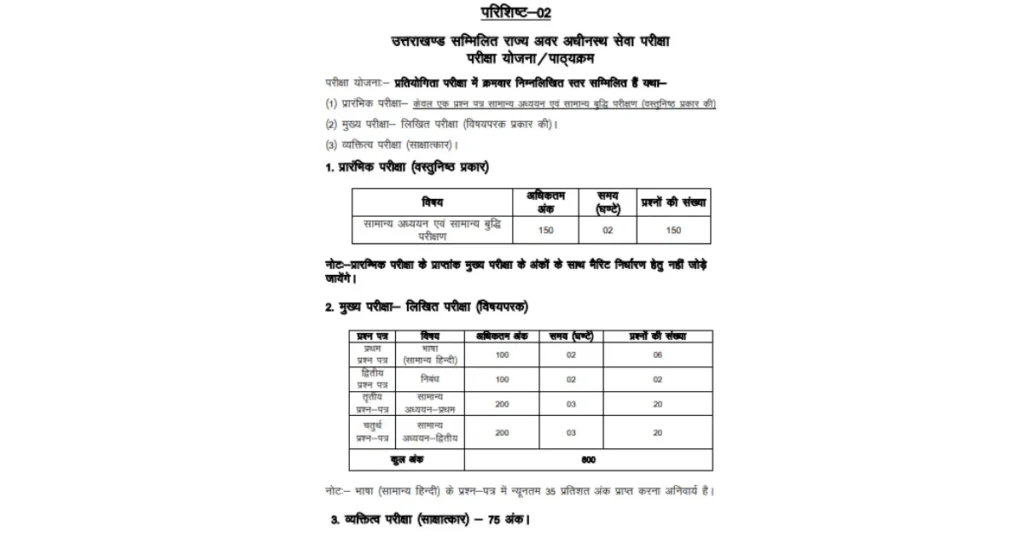
Table — Preliminary Examination
| Subject | Maximum Marks | Time | No. of Questions |
| General Study & General Aptitude Test | 150 | 2 Hours | 150 |
Table — Main Examination (Written, Descriptive)
| Paper | Subject | Maximum Marks | Time | No. of Questions |
| Paper I | Language (General Hindi) | 100 | 2 Hours | 6 |
| Paper II | Essay | 100 | 2 Hours | 2 |
| Paper III | General Studies – First Paper | 200 | 3 Hours | 20 |
| Paper IV | General Studies – Second Paper | 200 | 3 Hours | 20 |
| Total | 600 |
Note: A minimum of 35% marks in Language (General Hindi) is essential to qualify.
Personality Test (Interview): 75 Marks
UKPSC Lower PCS Prelims Syllabus
Part 1 – General Studies (Maximum Marks: 100, Total Questions: 100)
- General Science and Knowledge of Computer Operation
- History of India and Indian National Movement
- Indian Polity and Economy
- Geography and Demography of India
- Current Events (national and international, including games)
- History of Uttarakhand
- Culture of Uttarakhand
- Geography and Demography of Uttarakhand
- Economic, Political and Administrative Background of Uttarakhand
- (continuation of Uttarakhand’s administrative/economic background, land management and revenue system)
Part 2 – General Aptitude Test (Maximum Marks: 50, Total Questions: 50)
General Intelligence: verbal and non-verbal reasoning, analogies, similarities and differences, space visualization, problem solving, analysis, judgement, decision making, visual memory, discrimination, observation, relationship concepts, arithmetical reasoning, verbal and figure classification, arithmetical number series, and ability to deal with abstract ideas, symbols, and arithmetical computations.
UKPSC Lower PCS Mains Syllabus
Paper I – Language (General Hindi) — 100 Marks
Note: The official UKPSC syllabus for this paper is published only in Hindi in the source notification. The following is our English rendering for reference and should be read alongside the Hindi original.
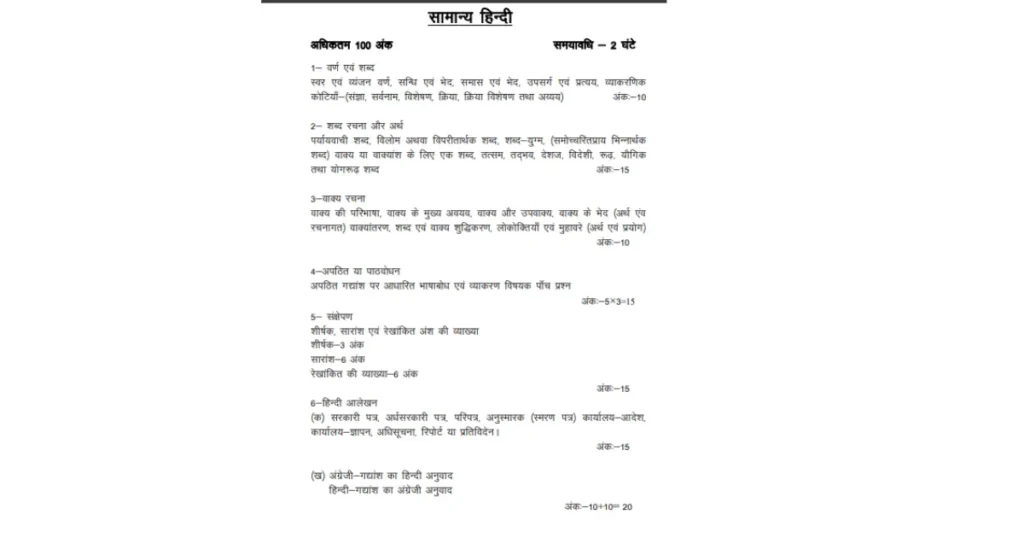
- Varn and Shabd (Letters and Words) — vowels and consonants, sandhi and its types, samas and its types, prefixes and suffixes, grammatical categories (noun, pronoun, adjective, verb, adverb, indeclinable) — 10 Marks
- Shabd Rachna aur Arth (Word Formation and Meaning) — synonyms, antonyms/opposite words, word-pairs (homophones with different meanings), one word for a phrase, tatsam, tadbhav, deshaj, videshi, rudh and yogrudh words — 15 Marks
- Vakya Rachna (Sentence Construction) — definition of a sentence, main parts of a sentence, sentence and clause, types of sentences, sentence transformation, word and sentence correction, idioms and proverbs (meaning and usage) — 10 Marks
- Apathit ya Pathvachan (Unseen Passage) — five questions based on comprehension and grammar from an unseen passage — 15 Marks
- Sankshepan (Précis Writing) — title, summary, and explanation of underlined portion (Title: 3 Marks, Summary: 6 Marks, Explanation of underlined portion: 6 Marks) — 15 Marks
- Hindi Alekhan (Hindi Drafting) — official letter, semi-official letter, circular, reminder note, office order, office memorandum, notification, report or representation — 15 Marks
- Anuvad (Translation) — English to Hindi translation, Hindi to English translation (10+10) — 20 Marks
Paper II – Essay — 100 Marks (2 Hours)
One essay of approximately 700 words from each of Section A and Section B.
Section A:
- Literature and Culture
- Social, Political and Economic topic
- National/International related topic
- Policies related to National development, Science and Technology
- Environmental and Natural Disaster (Landslide, Deluge, Drought and Earthquakes etc.)
Section B:
- Historical, Artistic and Cultural Scenario of Uttarakhand.
- Social and Cultural structure of Uttarakhand.
- Environmental protection and Disaster management in Uttarakhand.
- Role of women in Economy and Polity of Uttarakhand and Women Empowerment.
- Economic and Geographical scenario of Uttarakhand and its Tourism; Migration problem of Uttarakhand.
Paper III – General Studies First Paper — 200 Marks (3 Hours)
History, Art, Culture and Society of India
- Various art forms from ancient to modern period and their key elements; literature, painting, music.
- Bhakti Movement, Sufism, and their impact on Indian culture; main personalities.
- Social-religious movements and their impact on people and life.
- Indian architecture — main monuments and their chief characteristics.
- Ancient Indian history — important rulers and their contribution.
- Medieval India — important rulers, their policies, and transition to modern India (reasons for the decline of Muslim rule, situation of turmoil and transition to modern India).
- Modern India: power struggle between foreign powers in India, rise of the British, their policies and impact on India and Indians, major British rulers; impact of British economic policies; drain of wealth from India; establishment of railways and other means of communication and British economic interests; progress of education and British approach to Indian education policy; British policy towards Afghanistan, Burma, Tibet and its impact; British relations with native Indian rulers; policies like Subsidiary Alliance, Doctrine of Lapse, and their later effects.
- Freedom Movement: renaissance in India and its impact on the national movement; Mahatma Gandhi’s debut on the national stage; dimensions of the national movement from Non-cooperation to Cabinet Mission; participation of masses from different parts of India; farmer and tribal movements that gave impetus to the national movement; key personalities who provided ideological base to the national movement; Partition — conditions and causes.
- Challenges before India after Independence: economic challenges; building the nation through social and cultural initiatives; implementation of Five-Year Plans and later establishment of NITI Aayog.
History, Arts, Culture and Society of Uttarakhand
- History of Uttarakhand: pre-historic and proto-historic background (Stone Age tools, Painted Grey Ware culture, Megalithic cultures), excavated archaeological sites, sources for the cultural past of Uttarakhand (literary, archaeological, oral), ancient tribes and communities, Kunindas and Yaudheyas dynasty, administration and cultural contributions of Katyuri, Parmar and Chand dynasty, relations of Uttarakhand’s rulers with Delhi, Nepal and Sirmor in medieval times, invasion of Gorkhas and its impact, administration and slave trade, advent of European travelers, surveyors and missionaries, establishment of army cantonments and its social impact, colonial land and land revenue administration, forestry, excise policy, regional political organizations, press and journalism, Arya Samaj and Shuddhikaran movement, popular people’s protests — Coolie Begar, Dola-Palki, Gadi-Sadak, forest agitations, arrival of Gandhi in Uttarakhand (1915, 1929) and mass mobilization, local responses to Gandhian movements and popular participation, Indian National Army and its support base, Tehri Riyasat administration, Dhandhak, Prajamandal movement and merger into Indian Union, struggles for the formation of a separate state in Uttarakhand.
- Religious life and cults (Shaivism, Vaishnavism, Buddhism, Jainism, Nath Cult, Lakulish); temple architecture — types and features; rock art, metallic art, wooden art; traditional knowledge system and architecture; paintings, music, dance and songs; hydraulic architecture — Kup, Naula, Khal, Gharat; folk deity, jagar, Pandav Leela; dress, costumes and ornaments; fairs and festivals, pilgrimage and tourist spots — Hemkund Sahib, Nanak Matta, Kailash Mansarovar, Piran Kaliyar, Kumbh Fair, Char Dham Yatra, Nanda Raj Jat Yatra; folk musical instruments, food habits and local cuisines; important personalities of Uttarakhand (spiritual saints, freedom fighters, authors, artists); Garhwali and Kumaoni language and literature; government measures for conservation of language and culture.
Indian Constitution, Political System and Administrative System
- Evolution of Indian Constitution: history and Constituent Assembly debates; salient features; preamble and basic structure; amendment procedures and amendment acts.
- Rights and Duties: citizenship; fundamental rights; Directive Principles of State Policy; relationship between fundamental rights and Directive Principles; fundamental duties.
- Union and State Executive: President; Prime Minister and Council of Ministers — powers and functions; Governor; Chief Minister and Council of Ministers — powers and functions.
- Union and State Legislatures: Indian Parliament — powers and functions; State Legislatures — powers and functions.
- Indian Judiciary: Supreme Court — composition, powers and functions; High Courts — composition, powers and functions; judicial review; judicial activism.
- Elections and Political Parties in India: national and state parties; Election Commission of India; electoral laws; Model Code of Conduct; anti-defection laws; electoral reform measures.
- Indian Federal Structure: Centre-State relations — legislative, financial and administrative; Panchayati Raj and municipal institutions.
- Constitutional Bodies and Administrative Control Mechanisms: constitutional functionaries; constitutional, legislative and judicial control over administration.
- Administrative System and Administrative Reforms: NITI Aayog; different tribunals; e-Governance; Lokpal; Right to Information (RTI); Right to Education (RTE); Right to Public Services; Citizen Charters; role of ministries and departments; Administrative Reforms Commission (ARC) recommendations.
- National Integration and Challenges: insurgency; internal security; inter-state disputes.
Political and Administrative System of Uttarakhand
- Political and Administrative System of Uttarakhand: structure and processes.
- Legislative Assembly in Uttarakhand: powers and functions.
- Judiciary in Uttarakhand: appointment of High Court and lower court judges, powers and functions; Lok Adalat; Lokayukta; Uttarakhand Public Services Tribunal and judicial interventions.
- Political Parties in Uttarakhand: elections, leadership, anti-defection law, political participation and accountability.
- Local Self-Government in Uttarakhand: Panchayati Raj Institutions (PRIs) and urban local bodies; role of State Election Commission.
- Social Issues and Contemporary Problems in Uttarakhand: political and leadership issues; problem of corruption; role of civil society and media; anti-alcohol movement; problems of minorities, women and weaker sections in Uttarakhand; climate change; threat of glacial lake outburst floods from power projects; illegal mining; human-animal conflict; human trafficking and drug abuse.
- Administrative Services and Control in Uttarakhand: Uttarakhand Right to Service Act, 2011; social audit; citizen charter; Vigilance Establishment Uttarakhand.
- Social Schemes/Programmes in Uttarakhand: women and child, health and wellness, education and skill, business and entrepreneurship, agriculture/rural and environment, banking/financial services and insurance, housing and shelter, skill and employment, sports and culture.
- National Basic Services Schemes/Programmes in Uttarakhand: National Health Mission; Uttarakhand Renewable Energy Development Agency (UREDA); Uttarakhand State Rural Livelihoods Mission; Mahatma Gandhi National Rural Employment Guarantee Scheme; Veer Chandra Singh Garhwali Paryatan Swarozgar Yojana; Rural Enterprise Acceleration Project (REAP); Uttarakhand Skill Development Mission, 2013 (UKSDM); Deen Dayal Upadhyay Grah Aawas (Home Stay) Scheme.
- Government Initiatives for Social Inclusion: Uttarakhand Public Services (Reservation for Economically Weaker Sections) Act, 2019; Uttarakhand Public Services (Horizontal Reservation for Women) Act, 2022; 10% reservation in government jobs for statehood activists and their dependents; acts related to marginalized and other socially/economically weaker sections; State Uniform Civil Code.
Paper IV – General Studies Second Paper — 200 Marks (3 Hours)
Indian Economy
- Basic features of Indian economy, national income and per capita income (meaning and trends), sectoral composition and structural changes, problems of sustainable development, Human Development Index, inclusive growth — issues and policy initiatives, economic empowerment of women.
- Economic Planning in India: objectives, strategy, achievements and limitations, rationale, objectives and functions of NITI Aayog; regional imbalances, poverty, economic inequality, inflation and unemployment — meaning, causes, effects and policy initiatives.
- Trends of agricultural production, productivity and prices, commercialization and diversification, institutional and technological changes, agricultural price policy, rural credit — issues, progress and policy initiatives, food security — meaning, issues, progress and policy initiatives, farm subsidy — issues, problems, effects and policy initiatives, industrial production in India — trends and composition, industrial policy and its effects on growth, role of MSMEs, disinvestment — challenges and policy.
- Tax structure in India, Goods and Service Tax (GST) — concept, features, progress and limitations, fiscal federalism, fiscal policy and reforms, main features of the Union Budget, black economy — meaning, issues, estimates and policy initiatives, trend, direction and composition of India’s foreign trade, reforms in India’s external sector, India’s BOP performance and policy, India and economic international institutions/organizations/groups, public debt — issues and management, financial sector reforms in India, digital payments — issues, methods, effects and policy initiatives, inclusive finance, monetary policy of RBI.
- Broad demographic features of India, migration and economic development, issues related to urbanization, infrastructure sector in India — growth drivers and policy initiatives.
Economy of Uttarakhand
- Features of Uttarakhand economy, State GDP and per capita income, structural changes, natural and human resources, population and demography, forest, energy, agriculture and animal wealth, water resources and energy development, natural disasters, herbs and minerals.
- Trade, commerce and industry: inter-state trade, manufacturing, heavy/medium/small scale and cottage industries development, transport — roads, railways, airports: programmes and challenges.
- Public finance: budget, fiscal policy and fiscal reforms, taxes and taxation, public income and financial deficit, public expenditure and debt.
- Human development: Human Development Index, literacy and education system, poverty and poverty alleviation programmes, unemployment and employment schemes/programmes, health and sanitation, pension and insurance, social welfare and government schemes, displacement and migration, economic empowerment of women.
- Agriculture and rural development: major crops, fruit production, animal husbandry, agricultural holdings and land reforms, farmer welfare, Panchayati Raj, community development and cooperative movement, technological changes, agricultural marketing, Minimum Support Price, rural development schemes.
- Banking and finance: present scenario, development of banking and its contribution to State GDP, rural credit — challenges and policy.
- Tourism and pilgrimage: contribution of tourism and pilgrimage in economic development, economic importance of religious tourism, tourism development programmes and plans.
Geography of India and Demography
- Physical features of India; geological system and structure; relief, drainage and interlinking of rivers; climate phenomena (El-Nino, La-Nina, Southern Oscillation, Western Disturbances, consequences of climate change); soils degradation and deforestation; forest, forest products, wildlife sanctuaries, national parks, biodiversity hotspots; environmental problems and ecological issues in India; international boundaries of India and related geopolitical issues; salient features of Indian agriculture, agro-based activities, land reforms, problems of wasteland and their reclamation; mines and minerals, energy resources, energy crisis and search for alternatives; industrial development in India; major transport corridors, problems and prospects of civil aviation and water transport; regional disparities in economic development of India; natural hazards and disasters in India; regional consciousness and national integration of India based on physical and demographic characteristics, geographical basis of Centre-State relations; distribution and growth of population in India, demographic characteristics, dependency ratio, migration (interregional, interstate and international).
Geography of Uttarakhand, Demography and Disaster Management
- Geographical set-up and geo-political significance of Uttarakhand.
- Origin of Uttarakhand Himalaya, physiographic divisions of Uttarakhand and geographical conditions responsible for inhabitation in different physiographic divisions.
- Major rivers, their origin and significance — geographical, economic, cultural, environmental and religious.
- Major mountains and their significance — geographical, economic, cultural, environmental and religious.
- Climate including causes and effects of climatic diversity.
- Forest resources and factors affecting different forest types, forest diversity and physiography, altitudinal zones and climatic conditions, forest resources and economic development, conservation of forest resources.
- Development of horticulture and responsible geographical factors and climatic variability, challenges to horticulture.
- Major crops and geographical factors and climatic conditions responsible for crop diversity, causes and effects of crop rotation.
- Means of irrigation and geographical factors affecting their development, major irrigation projects, irrigation schemes, minor irrigation.
- Agricultural holdings — types and their causes.
- Natural and man-made calamities and disaster management — types, causes and their impact on human life; role of disaster management in natural and man-made calamities; efforts of Uttarakhand Government to mitigate the impact of disasters.
- Water crisis and watershed management — factors responsible for water crisis, impact of water crisis on human life, role of watershed management in mitigating water crisis, significance of and challenges to watershed management.
- Problems of remote areas — types and causes, environmental challenges, economic challenges, health challenges and access to basic services, efforts of Uttarakhand Government to overcome the problems of remote areas.
- Environment and Environmental Movements — major environmental movements, their causes and impact on the development of Uttarakhand, Chipko Movement, struggle for statehood.
- Biodiversity and its preservation — types of biodiversity, factors affecting biodiversity of Uttarakhand, Uttarakhand Himalaya as a Biodiversity Hot-Spot, relevance of biodiversity, threats to biodiversity/challenges to biodiversity, major initiatives for conservation efforts in Uttarakhand.
- Population of Uttarakhand — diversity in distribution, density, sex ratio, literacy and factors affecting them; migration and its causes and impact of out-migration.
Statistical Analysis, Graph and Diagram
- Statistical analysis of data through measures of central tendency, measures of dispersion, graphs and diagrams along with corresponding concepts of their application.
Current Events
- Current events of international and national importance along with games and sports related to:
(1) Global
(2) Asia
(3) India
(4) Uttarakhand
Qualifying marks (category-wise table)
| Category | Prelims | Mains | Final |
| Unreserved (UR) | 35% | 40% | 45% |
| OBC | 30% | 35% | 40% |
| EWS | 30% | 35% | 40% |
| SC/ST | 25% | 30% | 35% |
| Freedom Fighter Dependents | 25% | 30% | 35% |
| Divyangjan (PwD) | 20% | 25% | 30% |
| Ex-Servicemen | 25% | 30% | 35% |
FAQs
Q1. Is UKPSC Lower PCS Prelims marks counted in the final merit?
Ans. No. Prelims is qualifying only. Marks from Prelims are not added to Mains marks for merit determination.
Q2. What is the minimum qualifying mark in the Language (General Hindi) paper?
Ans. Candidates must score at least 35% in the General Hindi paper to qualify, regardless of their overall score.
Q3. How many marks are there for the Personality Test (Interview)?
Ans. The Personality Test carries 75 marks, in addition to the 600 marks for Mains.
Q4. Is there an optional subject in UKPSC Lower PCS Mains?
Ans. No. Mains consists of four compulsory papers — Language (General Hindi), Essay, and two General Studies papers. There is no optional subject choice.
Q5. Are the qualifying marks the same for all candidate categories?
Ans. No. Minimum qualifying percentages vary by category (Unreserved, OBC, EWS, SC/ST, and others) at each stage — Prelims, Mains, and Final selection.